Parallel Xceleration Library (PXL)
PXL is the core runtime library for the XCENA SDK. It provides APIs to manage device resources, load compute kernels, and run parallel operations on XCENA hardware.
Development Workflow
The XCENA SDK lets you offload computation to CXL memory accelerators:
flowchart TD
    subgraph PrepareOffloading[Prepare Offloading]
        direction LR
        OffloadingApplication[Offloading Application] --> |Build|ComputeKernel[Compute Kernel]
    end

    subgraph Accelerator
        direction LR
        Processor <--> |Process Kernel|CxlMemory[CXL Memory]
    end

    PrepareOffloading ==> |Load| HostApplication[Host Application]
    HostApplication <--> |API Call| RuntimeLibrary[Runtime Library]
    RuntimeLibrary <--> |Control| Processor
    RuntimeLibrary <--> |Allocate| CxlMemory
    HostApplication <--> |Data Access| CxlMemory
A typical project goes through these steps:
- Write a compute kernel in MU code.
- Write a host application using PXL APIs.
- Build both components.
- Run on hardware or the emulator.
For hands-on examples, see Tutorials.
Object Hierarchy
PXL exposes a small set of objects that model the host-to-device execution path:
flowchart LR
    Kernel[__pxl_kernel__] --> Launcher
    Launcher -.configures.-> Map
    Context --> Job
    Context -.owns.-> DeviceMem[Device Memory]
    Job --> Stream[default Stream]
    Job --> Map
    Map -.runs.-> Function
    Module --> Function
    Map -.takes.-> NDArray
    Map -.takes.-> DeviceMem
| Object | Role |
|---|---|
| Launcher | A high-level typed interface that configures and runs kernel requests without explicit Job / Map setup. |
| Context | A device session. Owns device memory and creates Jobs. |
| Job | A reservation of one or more Subs. Loads kernel binaries and creates Maps. |
| Module / Function | A compiled MU kernel binary and its callable entry points. |
| Map | One kernel launch — binds a Function to a taskCount and arguments. |
| Stream | An asynchronous work queue. Each Job has its own private default stream. |
| NDArray | A typed, shaped view over device memory that PXL automatically slices per task. |
In This Section
| Page | What it covers |
|---|---|
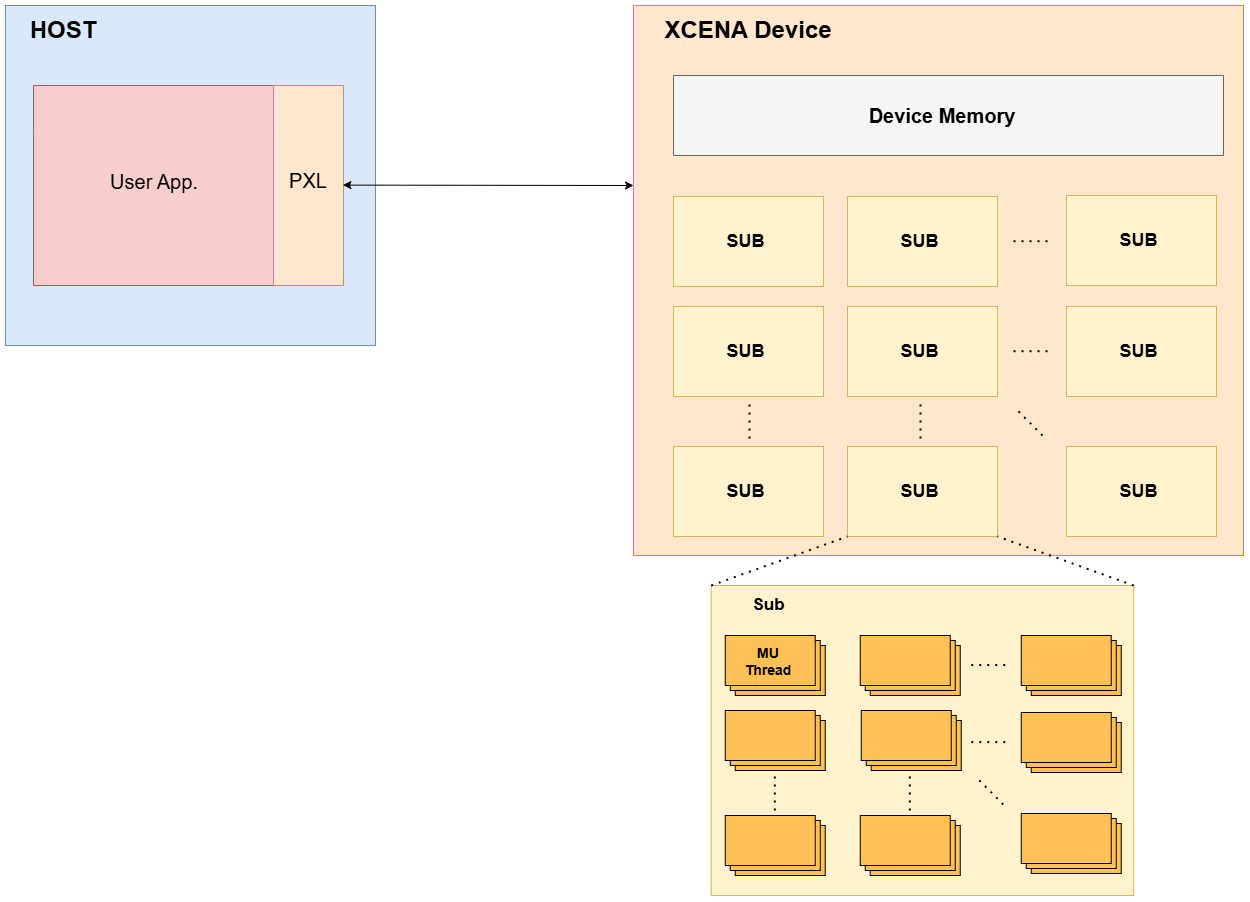
| Device Topology | Sub / Cluster / MU core hierarchy and how parallelism maps onto it. |
| Programming Objects | Launcher and the explicit Context / Job / Module / Function object model. |
| Kernel Execution | Launcher and Map execution, task distribution, arguments, locality, and lifecycle. |
| Streams | Asynchronous execution model, default stream behavior, and concurrency guidelines. |
Next Steps
- Tutorials — apply these concepts in working examples.
- API Reference — full PXL C++ API documentation.