Maru#
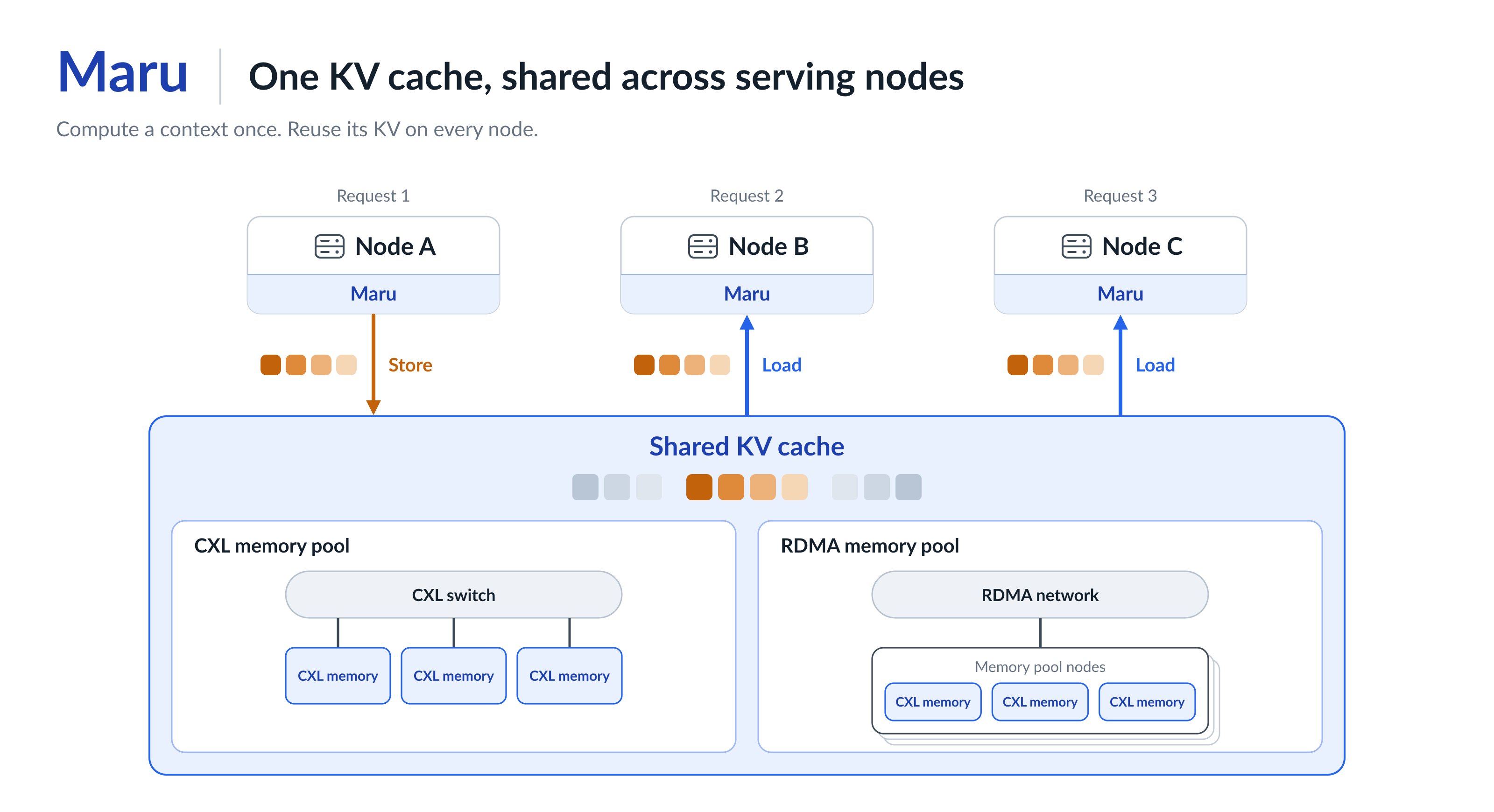
Maru is a high-performance KV cache storage engine built on shared memory pools, designed for LLM inference scenarios where multiple instances need to share a KV cache with minimal latency. Maru supports two kinds of pool. A CXL memory pool is CXL memory that nodes attached to CXL reach through a CXL switch. An RDMA memory pool is the CXL memory of memory nodes, which GPU nodes without CXL reach over an RDMA network.
Transfer-based sharing copies the KV across the network to every node that reuses it, byte by byte. As models get larger and contexts get longer, those copies become a structural bottleneck. On nodes attached to CXL, Maru takes the opposite approach: don’t move data, share the memory. Instances on those nodes read and write KV cache data directly in CXL shared memory, and only lightweight metadata (tens of bytes) travels between components. GPU nodes without CXL reach the CXL memory of memory nodes with one-sided RDMA: the NICs move the bytes, and no process on the memory node handles them.
Node A stores the KV it computes in a shared KV cache, and nodes B and C load it instead of recomputing. The shared KV cache lives in either kind of pool: nodes use the cxl backend for a CXL memory pool and the remote_cxl backend for an RDMA memory pool, and each node shares KV with the other nodes that use the same pool through the same backend.
Key Features#
Zero-Copy Sharing — Transfer-based systems — whether CPU-mediated or GPU-direct — require the receiver to allocate staging buffers and move data across an interconnect. On nodes attached to CXL, Maru eliminates this entire path: every instance reads from the same shared memory region directly. No buffer allocation, no data copy, no serialization. Nodes that reach the pool over RDMA move KV through a host staging buffer: the GPU copies it to and from the buffer, and the NIC moves it to and from the CXL memory with one-sided RDMA.
Scales with Context Length and Concurrency — Network-based sharing degrades as contexts grow and more consumers hit the same KV. On nodes attached to CXL, Maru never fans out KV payloads — scaling is bounded by shared-memory bandwidth, not network transfer.
Higher Hardware Utilization — Instead of duplicating KV caches per instance, all instances on a pool draw from one shared KV cache, held in a CXL memory pool or an RDMA memory pool. Less duplication means more usable memory and higher effective cache capacity.
Lower System Energy — On nodes attached to CXL, eliminating bulk data transfer cuts NIC and CPU power draw, and shorter data paths reduce GPU idle time per request.
GPU Nodes without CXL — With the
remote_cxlstorage backend, vLLM workers on GPU nodes without CXL keep their KV in an RDMA memory pool, the CXL memory of memory nodes. A remote CXL agent on each memory node maps regions and registers them with the node’s NIC, and workers read and write them with one-sided RDMA. An RDMA memory pool can span several memory nodes that share the same CXL memory, and a worker can use several RDMA memory pools. See the remote CXL example.
Architecture#
        flowchart TB
    subgraph S1["Server 1"]
        direction TB
        I1(["LLM Instance"])
        H1{{"MaruHandler"}}
        I1 --- H1
    end
    subgraph S2["Server 2"]
        direction TB
        I2(["LLM Instance"])
        H2{{"MaruHandler"}}
        I2 --- H2
    end
    subgraph S3["Server 3"]
        direction TB
        I3(["LLM Instance"])
        H3{{"MaruHandler"}}
        I3 --- H3
    end

    M["Maru Control Plane"]

    subgraph CXL["CXL Shared Memory"]
        KV["KV Cache"]
    end

    H1 & H2 & H3 <-.->|"store/retrieve"| M
    H1 & H2 & H3 <==>|"direct read/write"| CXL
    M -.->|"manage"| CXL
Control Plane (dashed arrows) — KV metadata operations and region allocation.
Data Plane (solid arrows) — on nodes attached to CXL, direct access to CXL shared memory, zero-copy. The data path is identical regardless of control plane mode.
GPU nodes without CXL use the remote_cxl storage backend. Their KV stays in an RDMA memory pool, the CXL memory of memory nodes: a remote CXL agent on each memory node maps the regions a worker asks for and registers them with the node’s NIC, and the worker reads and writes them with one-sided RDMA (NIXL/UCX). The agent is needed because one-sided RDMA reaches only memory that a process on the memory node has mapped and registered with its NIC, and a worker without CXL cannot map the region itself. Only control messages go to maru-server and the remote CXL agent.
See Architecture Overview for the full design, including the remote_cxl backend.
Benchmark#
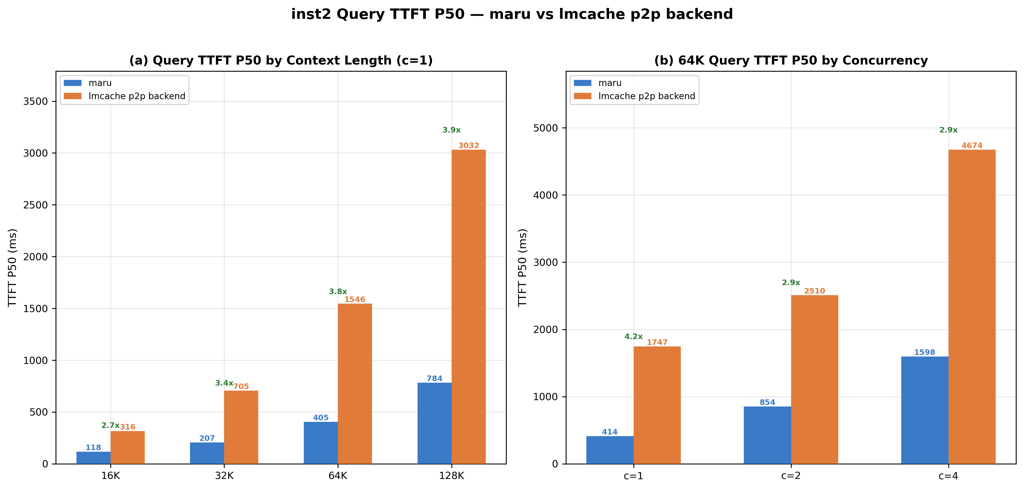
P2P KV cache reuse, meta-llama/Llama-3.1-8B-Instruct, single-node. TTFT P50 (ms), lower is better. Multi-node results coming soon.
See full benchmark results for detailed TTFT, concurrency, and power efficiency comparisons.

Maru (/mɑːruː/) — named after the maru (마루), the central open floor in traditional Korean architecture where all rooms connect and people freely gather and share.
Getting Started#
Quick Start — Single-host and multi-host KV sharing
Future Work#
NUMA node support for CXL memory — Currently Maru requires CXL memory to be exposed as devdax devices (
/dev/dax*). We plan to support CXL memory mapped as NUMA nodes, enabling broader hardware compatibility and simplified deployment.Direct integration with more inference frameworks — Native KV cache connector for SGLang, enabling zero-copy shared memory without intermediate middleware dependencies.
CXL-based Near Data Processing (NDP) — Offloading KV cache operations — such as compression/decompression, prefix matching, and eviction scoring — to compute-capable CXL devices, reducing host CPU overhead and data movement.